Programme Director, Ross Millen, brings a wealth of experience to his role. His enthusiasm for the digital and hardware computing industry is evident in his teaching and design of EKC Ashford College Computing and Digital courses.
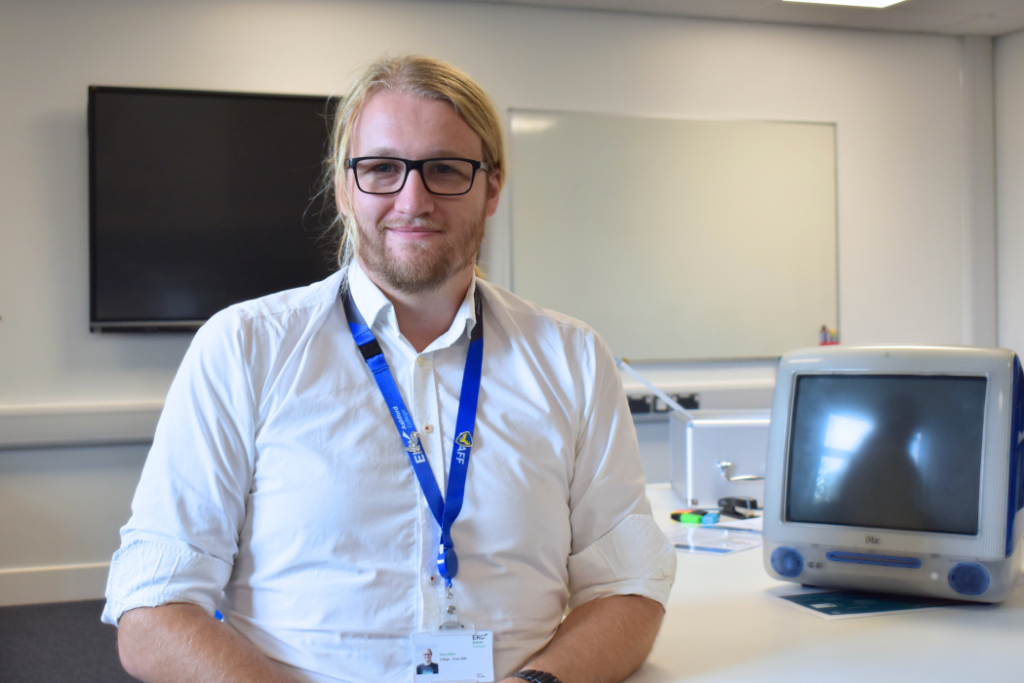
His experience as an audio-visual programmer, smart-system design programmer, and GCSE and A Level lecturer have led him to his role at the College.
Why do you like computers?
“I just enjoy finding out how stuff works; how computers work, how general technology works, how cars work, how electrical systems work, how all sorts of things work.
“Computers are complex and an accessible way of having that interest. If you’re younger and have an interest in how things work, it’s very difficult to convince someone to let you take a car to pieces. But it’s a lot easier for someone to say, ‘Oh, I’ve got an old laptop I’m going to throw away.’ That’s kind of always been my focus, where it’s been an accessible form of tinkering.
“That’s what I like to instil with the students as well. In the past, I’ve run a Computing club for an hour at the end of the week where I say to them, ‘Right, here’s the room full of all the old technology. Let’s do something.’ And they can just have a play with it.”
Why did you shift from teaching in secondary school to Further Education?
“I think that the T level and the Level 2 qualifications that we’ve now shaped and deliver here are a lot more in line with what’s going to be expected of a student when they would go to apply for a job.
“If someone’s done a GCSE in Computer Science and they go and apply for IT Support as a role, they’re not going to be particularly ready.
“I felt that these courses were much more industry appropriate compared to the secondary education offering.”
How do you design your curriculum?
“I don’t tend to teach like a sequence of units. I teach with a set of activities or a project over a few terms that match up with the various assessment points and criteria as we go.
“So you can teach it like unit 1, 2, 3, 4, 5, but I feel that that kind of misses the context.”
What sort of student would do well in your courses?
“Ideally, they’d have an interest in how a machine or computer works or how to create their own programme. They don’t need to be the most confident, but to be inquisitive.
“I have students that will come in and say, ‘Did you see this thing in the news that’s happened?’ We can have that discussion. But generally, having and interest and asking questions, makes for a good student.”
Do you want to learn the skills need to thrive in the computing industry? Explore our Computing and Digital courses and apply today.
More articles

Meet your Students’ Union President of EKC Ashford College

Celebrating the success of EKC Ashford College GCSE Maths adult learners